
One Click Metal Showcases Surgical Tools Made with Additive Manufacturing
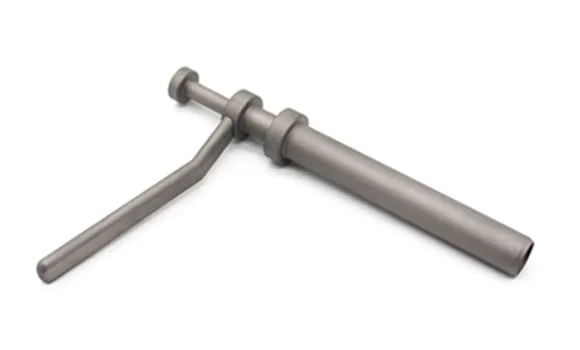
The triple drill sleeve ensures highly accurate alignment when drilling into bone (Courtesy One Click Metal)
One Click Metal, Tamm, Germany, has highlighted metal Additive Manufacturing as a significant method changing the way that medical tools and surgical instruments are designed and manufactured. Hospitals, research institutions, and medical device companies increasingly rely on AM to produce precise, durable, and customisable tools that support modern surgical procedures, the company stated.
Metal AM enables the production of highly complex internal and external geometries that cannot be produced using conventional machining. Features such as integrated channels, ergonomic shapes, lightweight structures and optimised cutting edges enhance both surgical efficiency and instrument handling.
Additive Manufacturing also supports the creation of custom surgical guides and tools tailored to the patient, especially useful in orthopaedic and maxillofacial surgery.
Additionally, stainless steel (316L/1.4404) and titanium (Ti6Al4V) offer high strength, corrosion resistance, biocompatibility and long product life, making them ideal for reusable medical instruments.
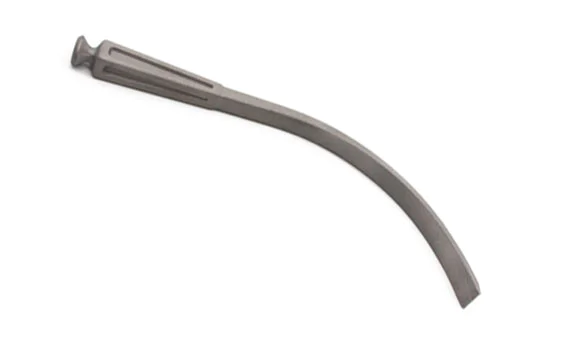
This curved chisel is used in orthopaedic surgery to cut, shape, or remove bone with high precision (Courtesy One Click Metal)
One Click Metal stated that hospitals, such as Lerdsin Hospital in Bangkok, use metal AM to prototype surgical instruments quickly, enabling faster iteration and reduced development costs. These include a curved surgical chisel used in orthopaedic surgery to cut, shape, or remove bone with high precision (above), and a triple drill sleeve ensures highly accurate alignment when drilling into bone, a crucial factor when placing screws for fixation systems (top).
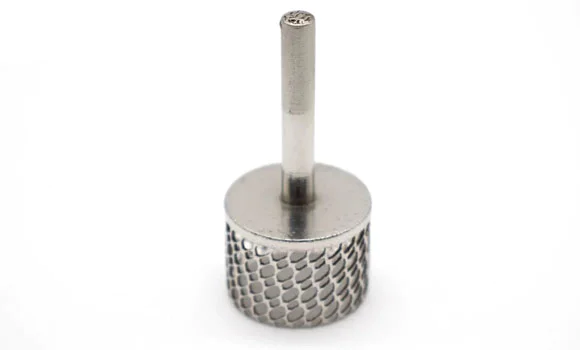
The 316L stainless steel core drill took six 6 hours to additively manufacture for MDE (Courtesy One Click Metal)
MDE in Villa Carcina, Italy, is also reported to utilise a core drill, widely used for tissue sampling, allowing cylindrical specimens to be removed for histological examination. One Click Metal said that MDE chose metal AM because the tool’s complex cutting edges and internal geometry are difficult, or impossible, to achieve using conventional machining.